
Strategic time has compressed. In periods of realignment, dangers persist, competition continues, and opportunities remain available only for a limited time. In just a few years, positions can be established that will shape the decades ahead.
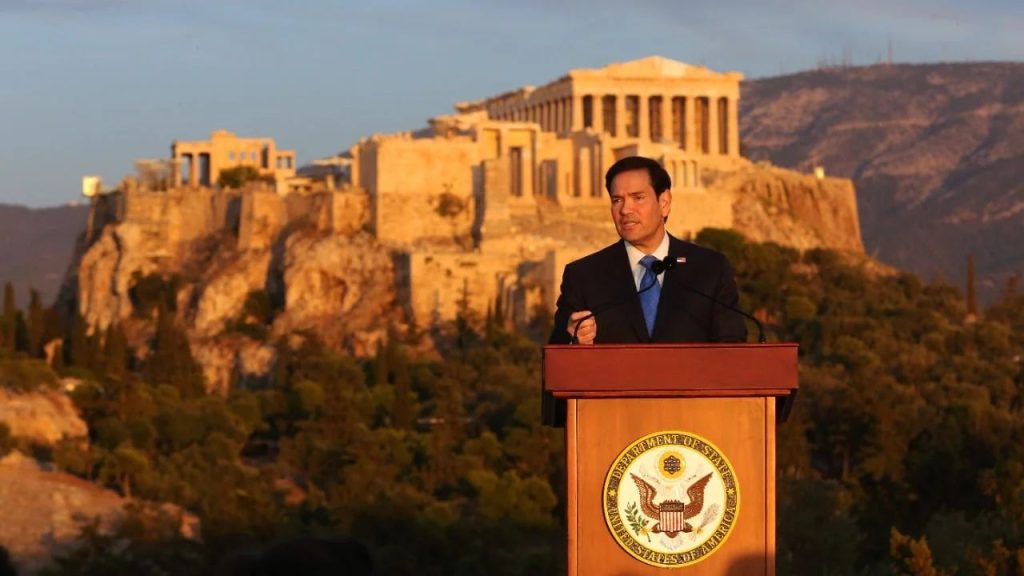
This, in my view, is the perspective from which Secretary of State Marco Rubio’s speech in Athens deserves to be read. Beyond its historical and cultural depth, the speech carries a very concrete political message: the relationship between the United States and Europe in a globalized world that has returned to an era of competition and challenges to American and Western leadership.
America’s message to Europe is direct. After years of „business as usual,” the Trump administration has set in motion a broad effort to strengthen American power through reindustrialization, rebuilding defense capabilities, securing greater control over critical supply chains, and intensifying competition for the technologies and industries of the future: energy, artificial intelligence, semiconductors, critical minerals, cybersecurity, and space.
The Trump administration is pursuing a range of economic, industrial, technological, and security policies aimed at strengthening America’s national power. And the United States, through Secretary of State Rubio, is calling on Europe to „wake up” and stand alongside America. Rubio uses precisely this image: Europe can „awaken from its long slumber” and rekindle the fire first ignited here, in Greece, thousands of years ago.
This, I believe, is the political core of the speech.
Washington already sees signs of change in Europe: increased defense spending, new programs and partnerships, and expanding industrial and manufacturing capabilities. In this context, Greece is presented as an example of a relevant ally across areas ranging from defense and energy to migration. And the message to the rest of the continent is explicit: America hopes Europe will follow this path.
Rubio also addresses the tensions that have emerged in the transatlantic relationship. He acknowledges them but immediately emphasizes the way forward: the bond between the United States and Europe must be strengthened, and the alliance must be built to meet the threats of our time. Transatlantic friendship is presented as a relationship in which combined strength can exceed the sum of individual capabilities. His message is simple: „We want to win together. We must win together.”
His argument is that America and Europe share a common civilizational history. America itself is portrayed as a continuation of a tradition born in Athens, shaped by Rome, carried through European Christendom, and eventually brought across the Atlantic.
First, he defines who „we” are. Then he explains what this „we” must do.
That is why he emphasizes the kind of individual who made the West possible: curious, ambitious, courageous, competitive, and driven by knowledge and excellence. In one of the speech’s most powerful passages, he describes the Greek city-state as „an arena in which people could test themselves and prove their worth, refine their potential through constant competition — to be the best, the strongest, the most beautiful, always striving to approach perfection.”
This historical reflection also helps explain his diagnosis of the contemporary West. Rubio speaks of a loss of confidence in Western civilization, weakened military capabilities, the offshoring of industry, and the transfer of decision-making beyond the control of nation-states. In his reading, the vacuum left by Western weakness has been filled by competitors who have steadily built up their power and confidence.
This is where his appeal to Europe comes from. The European awakening Rubio describes is simultaneously cultural, political, industrial, and military.
Europe must regain confidence in its own civilization, along with the concrete ability to defend it.
Values need instruments. Ambition needs industry. Sovereignty needs power. Alliances need capable allies.
Within this framework, the transatlantic relationship is also given a clear political definition. Rubio argues that the purpose of institutions and alliances is to defend the sovereignty of the states that constitute them. National identities and shared interests can coexist and reinforce one another.
This is an important proposition. For the current U.S. administration, a strong ally understands its own interests, assumes responsibility, and contributes to collective strength. The transatlantic relationship thus becomes an alliance among capable states, each bringing resources, determination, projects, and influence to the table.
Following the same logic, the dividing line between economics and security is becoming increasingly blurred. Rubio explicitly connects reindustrialization, energy, advanced technologies, drones, weapons systems, semiconductors, critical minerals, and cybersecurity to national power.
Industry becomes security. Energy becomes security. Technology becomes security. Supply chains become security.
This is the world in which we must also think about Romania.
We have reasons to be confident. A remarkable segment of Romania’s younger generation is already demonstrating that it is ready for this world. The achievements of Romanian students in international competitions in artificial intelligence, computer science, science, and space engineering reveal a wealth of intelligence, creativity, and ambition that Romania must learn to retain, develop, and put to work.
These young people represent more than individual achievements. They are evidence of the untapped potential of younger generations of engineers, researchers, entrepreneurs, and innovators who will shape tomorrow’s economy. And the development of high-value-added industries means well-paying jobs, a more competitive economy, and a stronger economic foundation for financing education, healthcare, and public services. This is where foreign policy, security, and prosperity converge in a very tangible way.
Romania established its fundamental strategic choices long ago: NATO, the European Union, and the Strategic Partnership with the United States. The shift to a new era now raises a different question: How do we turn membership into relevance, and relevance into influence that, completing the circle, serves our national economic, political, and other interests?
The answer lies in building national capabilities: infrastructure, industry, energy, defense, connectivity, technology, strong political relationships, and projects that create shared interests over the long term.
Romania’s geopolitical position offers significant opportunities. The Black Sea, the Danube, NATO’s eastern flank, proximity to Ukraine, energy potential, and connectivity corridors can all enhance Romania’s role in the region. But geography does not, by itself, automatically generate geopolitical value. It does so only when national effort and visionary political leadership, oriented toward both national and regional/international objectives, deliberately and systematically translate geographic advantages into projects, continuity, implementation capacity, and tangible results on the ground, consistently and coherently.
Here, I see one of the most important conclusions of Rubio’s speech for Romania: a relevant ally is a capable, predictable, and credible ally. A state that understands its own interests, recognizes shared interests, and comes to the alliance table with concrete solutions and contributions.
Romania can pursue an additional objective: not merely to participate in solutions designed by others, but to bring forward its own ideas, projects, and new frameworks for cooperation. In a period of realignment, relevance also grows from the ability to propose solutions.
The Athens speech is, fundamentally, an invitation to Europe. America reaffirms its belonging to the same civilization, declares its intention to rebuild its power, and calls on Europe to do the same. It is a message of alliance, but also of responsibility.
America needs a capable Europe. Europe needs an engaged America. And the West needs both.
For Romania, these dynamics present a wealth of opportunities. But strategic opportunities have one defining characteristic: they do not remain available forever.
Strategic time has compressed, and the pace at which history is being made has accelerated significantly.
States that understand the transformation, define their interests, and act within the window of opportunity can secure and strengthen their relevance in the international order now taking shape in real time.
In this context, political parties face a national responsibility fundamentally different from the one they faced yesterday, when we operated within a relatively stable geopolitical status quo. They now have the historic task of articulating and advancing the country’s interests in a far more dynamic and intensely competitive global political environment, where the price of admission to strategic relevance is national capability.
Are they genuinely and concretely focused on this responsibility? Do the leaders of these parties — not only their chairpersons, but also those around them who naturally influence their decisions — devote time every day to strategic thinking and to contributing to this national mission?
Are there discussions across party lines on these matters of major national importance, beyond the familiar focus on the National Recovery and Resilience Plan (NRRP) and cost management?
Do today’s political parties understand that, by changing the mindset through which the country’s political leadership is exercised and broadening their strategic horizon, they could also address domestic challenges more effectively?
That remains to be seen.